Word puzzles come in many shapes: unscrambling letters, hunting for words in a grid, guessing a hidden word letter by letter, or swiping across tiles to melt them off a board. They look different but rely on the same few skills: recognising common letter patterns, scanning quickly and keeping a flexible mind. This guide collects the techniques that help in all of them, with examples from WordMelt, Word Scramble, Word Search, Hangman and Word Daily on OnlinePlayZone.
Know which letters are common
English letters are not evenly spread. The most frequent are E, T, A, O, I, N, S, H and R. The rarest are Q, Z, X and J. When you guess in Hangman or Word Daily, starting with common vowels and consonants gives the most information. When you scan a grid, the rare letters act as anchors: there are few words with a Q or Z, so those tiles narrow your search a lot.
Learn prefixes and suffixes
Many English words are built from a stem plus an ending or beginning. Learn to see them as chunks. The endings ING, ED, ER, EST, LY, S and ES appear everywhere, and so do the beginnings RE, UN, IN, DIS and PRE. In a swipe game such as WordMelt, a board with an I, an N and a G near each other probably contains an ING. In an anagram, spotting an ED or an ING at the end often leaves a shorter word that is much easier to find.
Common letter pairs and clusters
Certain letters like to sit together. TH, SH, CH, ST, TR, BR, CL, PL and ER are very common. After a Q you almost always get a U. In English, double letters are most often LL, SS, EE, OO and TT. Keeping these combinations in mind lets you rule out impossible arrangements and make better guesses.
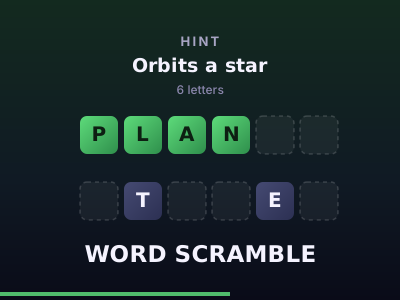
Technique for anagrams
- Put the letters in a different arrangement, for example in a circle, to break the order you first saw.
- Pick out any common ending and set it aside.
- Pick out common beginnings.
- Find the vowels and try combining them with the consonants around them.
- Say the possibilities out loud. Your ear often recognises a word before your eyes do.
Technique for word search grids
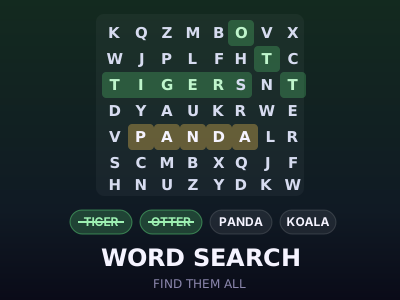
In a word search, do not scan for the entire word. Scan for the first letter, then check the eight directions around it for the second letter. Better yet, scan for the rarest letter in the word, because there are fewer of them. When you find one, check around it for the rest. Words can run in any direction, including backwards and diagonally, so remember to train your eyes to look in all eight directions.
Technique for swipe games
In WordMelt and similar games, tiles are connected to their neighbours including diagonals. Start with the awkward letters, such as J, Q, X, Z and K, while there are still plenty of neighbours. Then plan a move ahead: the tiles above a melted word fall into the gaps, so letters that are far apart now can end up side by side. Do not always take the longest word. A short word that frees a stranded tile can be better than a long word that leaves a lonely letter behind.
Technique for guessing games
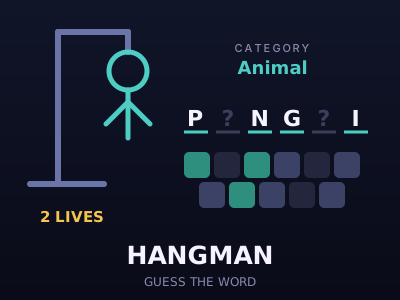
In Hangman, begin with vowels, especially E, A and O, then move to common consonants such as T, N, S and R. Look at the pattern of blanks. A word with a double blank in the middle might have a double letter. If you know the category, narrow the list of possible words in your head and choose the letter that appears in the most of them. In Word Daily, use your first guess for a word with many different common letters, and your later guesses to test positions.
Grow your vocabulary as you play
Word games are a gentle way to meet new words. When you find a word you do not know, look it up, read the example sentence and try using it in conversation or writing. A word that you have used once is a word you will recognise in future puzzles. Some players keep a small list of new words they have learned from games.
Keep it fun
Word puzzles should feel relaxing. If you feel stuck, leave the puzzle for a few minutes and come back. The brain keeps working in the background, and an answer that eluded you often appears when you return. With regular short sessions you will see patterns more quickly, and puzzles that felt hard will feel natural.
A method for daily five-letter puzzles
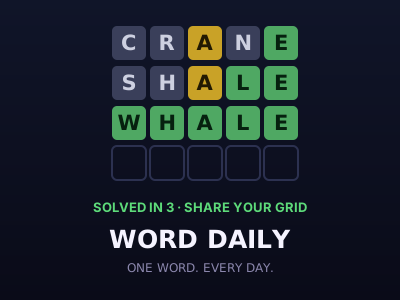
For games where you guess a hidden word and receive hints about which letters are correct, think in terms of elimination. Use your first guess to test common letters, such as one with several vowels and common consonants. Use each hint to narrow the possibilities: a letter that is marked correct stays in place, a letter that is in the word but in the wrong place must move, and a letter that is absent is crossed off for good. On the third guess, try a word that tests letters you have not yet tried, even if it cannot be the answer, so that you learn as much as possible before committing.
Keep a small word notebook
Players who improve fastest keep a short list of new words they have met, with a few words of meaning and an example. Review it once a week. Because words come back in puzzles, a word you wrote down is far more likely to be recognised the next time you see its letters.
Play for the pattern, not the score
If you stop worrying about getting every puzzle right, you will relax and notice more. Treat each game as practice at spotting patterns, and success tends to follow.
Frequently asked questions
Do word games improve vocabulary?
They expose you to words and word patterns repeatedly, which helps you notice and remember them. Looking up a new word you meet is the best way to make it stick.
What are the most common letters in English?
E, T, A, O, I, N, S, H and R appear most often. Knowing this helps you guess in games such as Hangman and Word Daily.
How do I find words faster in a grid?
Look for common endings such as ING, ED, ER and S first, then work backward. Scanning for the rarest letters, such as Q and Z, also gives you clear starting points.