About Word Daily
A new five-letter word every single day, six guesses, green and yellow clues. Everyone in the world gets the same daily word, and your result shares as a grid of coloured squares that never spoils the answer. Streaks, stats, and an unlimited practice mode.
Word Daily is free to play with no download or sign-up, on desktop with a keyboard or mouse and on mobile with touch controls.
More Word games
Word Daily — how to play and tips
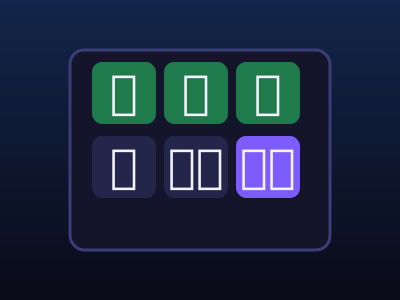
Word Daily is a five-letter word puzzle with a new word every single day. You get six guesses to find it. After each one, every letter is colour-coded: green means the letter is correct and in the right position, yellow means the letter is in the word but somewhere else, and grey means it isn't in the word at all. Narrow it down guess by guess, using the feedback from every previous attempt, and solve it before you run out of tries. Alongside the daily puzzle there's also an unlimited practice mode for whenever you want to keep playing after finishing today's word.
How to play
Type your guess on your physical keyboard, or tap the letters on the on-screen keyboard shown below the board. Press Enter to submit a guess and Backspace to delete a letter you've typed. Only real words from the game's word list are accepted as guesses, so you can't burn one of your six tries on a random string of letters — every guess you submit has to actually be a word, even if it isn't the right one. The on-screen keyboard colours itself in as you play, marking letters you've already tried as green, yellow or grey, so at a glance you can see which letters are still worth guessing and which ones you've already ruled out.
Everyone gets the same word
The daily word is chosen from the calendar date in UTC, not from a random number generated per visit, so every player in the world is solving the exact same puzzle on the same day regardless of time zone. That's what makes comparing results meaningful — if a friend on the other side of the world says they solved it in three guesses, you know exactly how impressive that was, because you were both looking at the identical word. The puzzle number shown in the HUD ticks up by one each day, giving every day's word a stable, shareable identity.
Share your result without spoiling it
When you finish a daily puzzle, whether you solved it or ran out of guesses, the Share Result button copies a grid of coloured squares to your clipboard showing the shape of your solve — how many guesses you took and how close each one was to the answer — but never the letters themselves. It's completely safe to post publicly on social media or send to a group chat, because the grid gives nothing away about the actual word to anyone who hasn't played yet, while still letting people who have played compare how efficiently they solved it.
Streaks and stats
Your games played, win percentage, current streak, longest streak ever reached, and a breakdown of how many guesses you typically need to solve the puzzle are all stored locally on your own device, so they carry over from one day to the next without needing an account or sign-up. A streak only continues if you solved the previous day's puzzle too — miss a day, or fail to solve it within six guesses, and the streak resets back to zero the next time you play. Practice mode is deliberately excluded from all of these statistics, so playing unlimited practice rounds can never quietly inflate your daily win percentage or streak count; only genuine daily attempts count toward your record.
Practice mode
The daily puzzle is one word per day by design, which is part of what makes it worth returning to — but if you want to keep playing right away, practice mode serves random words from the same word list with no limit on how many you can attempt. It uses the identical rules and the identical colour feedback as the daily puzzle, so it's genuinely useful for warming up or building intuition, but it has no effect whatsoever on your daily streak or statistics, keeping the two modes cleanly separated.
Strategy
A strong opening guess uses five different, common letters rather than repeating any of them — words like CRANE, SLATE or AUDIO cover a lot of ground fast because they combine frequently used consonants with more than one vowel. Resist the urge to lock in on green letters too early in a puzzle; if you already have two greens confirmed but no real information about the remaining letters, a guess that tests five brand-new letters often teaches you more useful information than one that reuses letters you already know, even though that guess itself can't possibly be the final answer. Pay close attention to yellow letters as well as green ones — a yellow tells you a letter belongs somewhere else in the word, and ruling out the position it just failed in narrows the remaining possibilities almost as much as a green does.
Guides for Word Daily players
- How to Solve Sudoku: Techniques from Beginner to Advanced — A step-by-step Sudoku guide covering scanning, naked and hidden singles, pairs and the first advanced patterns, with a routine you can practise.
- Word Puzzle Strategies: Anagrams, Word Search and Swipe Games — Practical techniques for word puzzles: letter patterns, common prefixes and endings, scanning methods and how to build your vocabulary while you play.