Puzzle games ask you to think. There is no time pressure in most of them, and the satisfaction comes from the moment a messy situation suddenly makes sense. They range from classic grids such as Sudoku and Nonogram to sorting games, tile merging games and physics puzzles.
The best puzzle games share two qualities. First, they teach you a small set of rules quickly. Second, they hide a surprising amount of depth behind those rules. A Sudoku grid has nine numbers and one rule, but the techniques for solving the hardest puzzles fill books. A tile-merging game has four swipe directions, yet the difference between a casual player and a careful one is large.
Our puzzle library includes daily puzzles that change every day and are the same for every player in the world, which makes them a good habit to build. Many puzzle games also include undo and hint features, so you can experiment without fear and learn by trying.
How to get started
- Read the rules once, then experiment. Most puzzle games teach by doing.
- When you get stuck, look away for a minute. The answer often arrives when you return.
- Use the guides below to learn the techniques for specific puzzles.
All puzzle games (11)



What each game is about
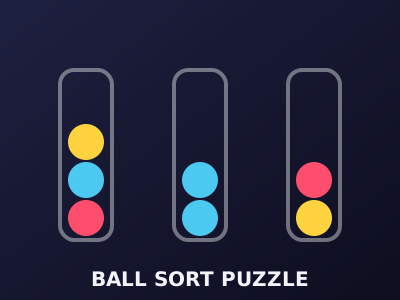
- Ball Sort Puzzle — Pour colored balls between tubes until every tube holds a single color. A relaxing, addictive sorting puzzle with endless levels and a handy undo button.
- Memory Match — Flip the cards, remember the icons, and clear the board in as few moves as possible. A calm, brain-training classic that works great on any screen size.
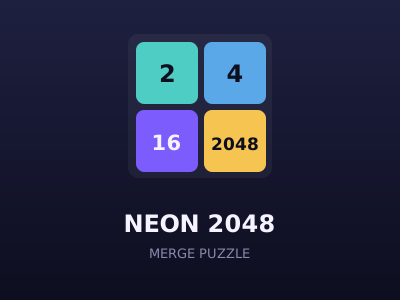
- Neon 2048 — A neon take on the classic number puzzle. Swipe or use the arrow keys to slide every tile at once — matching numbers merge into their sum. Reach the 2048 tile, then keep going for a high score.
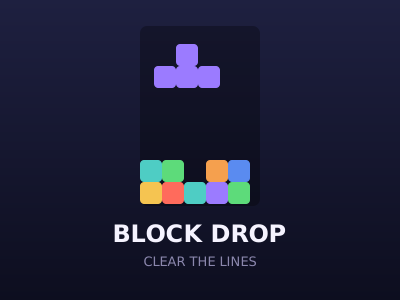
- Block Drop — A falling-block puzzle with seven classic shapes. Rotate and slide them to complete horizontal lines, with a ghost outline showing exactly where each piece will land. Clear four rows at once for the biggest score.
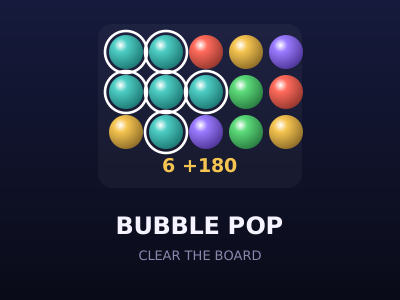
- Bubble Pop — A cluster-clearing puzzle. Tap a group of touching same-coloured bubbles to select it, tap again to pop. Bigger groups score exponentially more — a group of ten is worth 25× a pair — and the board never refills.
- Mine Sweeper — The classic logic puzzle, done properly. Use number clues to deduce where every mine hides, flag them, and clear the field. Three difficulties, a guaranteed-safe first click, long-press flagging on touch, and chord clicks for fast play.
- Maze Runner — A freshly generated maze on every single level. Escape from the top-left corner to the glowing exit, grabbing coins on the way, before the timer runs out. Mazes grow from 7×9 up to 21×25 as you climb.
- Sokoban — The classic box-pushing puzzle across 10 levels. Crates can only be pushed, never pulled, so one wrong shove can lock a level forever — unlimited undo included. Every level verified solvable.
- Nonogram — Picross-style logic puzzles solved with numbers, not guesses. A new daily grid in three sizes plus unlimited practice, with drag-to-paint, X marks, and clues that dim as each line is satisfied. Any valid solution is accepted.
- Gem Swap — Classic match-three. Swap neighbouring gems to line up three or more, chain cascading combos for up to a 6× multiplier, and build star gems that detonate a whole row and column. 30-move and 90-second modes.
- Sudoku — Classic 9×9 sudoku with a new daily puzzle in four difficulties, plus unlimited practice. Pencil marks, undo, hints and mistake tracking. Every puzzle is verified to have exactly one solution, so it is always solvable by logic alone.
Guides for puzzle games
How to Solve Sudoku: Techniques from Beginner to Advanced
A step-by-step Sudoku guide covering scanning, naked and hidden singles, pairs and the first advanced patterns, with a routine you can practise.
Strategy2048 Strategy: How to Keep Control of the Board
The corner strategy, why you should avoid certain moves, how to merge in chains and how to recover from a crowded board in 2048-style games.
StrategyMinesweeper Logic: Reading Numbers and Guessing Safely
How to read Minesweeper numbers, the patterns that reveal mines, and how to choose the best guess when logic runs out.