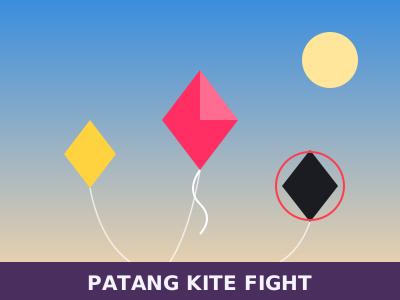
If you have ever stood on a rooftop in January and watched hundreds of kites fill the sky, you know that Indian kite flying is more than a pastime. It is a competition. Two flyers lock their strings in a pech, one pulls and the other lets go, and a moment later one kite drifts away free and a cheer goes up: kai po che, or woh kata. This guide explains the techniques behind that moment and how we turned them into the games Patang Pech and Patang Kite Fight on OnlinePlayZone.
The basic vocabulary
- Patang is the kite itself, usually a lightweight diamond of paper on a bamboo frame, with a thin tail or none.
- Manjha is the string used in fights. Traditionally it was cotton thread coated with a mixture of gum and powdered glass, which makes it abrasive.
- Charkhi or firki is the spool that holds the string.
- Pech is a duel: two kites whose strings have crossed.
- Dheel means to loosen, to give slack.
- Khench means to pull.
- Kata means cut. When a kite is cut, the cutting flyer shouts "woh kata" or, in Gujarati, "kai po che".
How a kite string actually gets cut
When two strings cross, nothing happens until one of them moves. Cutting is friction. The abrasive coating on one string saws against the other as one or both lines slide across the contact point. The harder the strings are pressed together and the faster they slide, the more wear. Eventually a line breaks, and the kite attached to it floats away.
That description already explains the two famous moves. When you khench, you pull in string quickly, so your line slides across the rival's line at speed under tension. When you dheel, you let string out quickly, which also makes your line run across the rival's, and a slack string does not offer the rival's line anything solid to bite into.
Height matters
Experienced flyers say that the higher kite has the advantage in a pech, and the reason is geometry. If your kite is above the rival's kite, your string comes down onto theirs, and pulling in your line saws downward across it. If your kite is below, your line goes up to meet theirs, and the best move is often to release string quickly so that your line slips along theirs. This is why flyers spend the early part of a fight trying to climb above a rival.
The dheel-khench combination
The classic attack combines the two moves. A flyer lets string out to rise above or move away from the rival, then pulls in sharply at the moment the strings meet. The slack stage keeps your own line safe and builds height; the pull stage delivers the cut. In Patang Pech we modelled exactly this. When you hold the dheel button, your kite drifts far away and looks smaller and smaller in the sky. When you hold khench, it comes back toward you and your string saws across the rival's.
Tension and stamina
Pulling hard for a long time tires the flyer, and a taut line is a vulnerable line, because a tight string cannot slide away from the rival's string. A good flyer alternates: pulls hard for a moment, then gives some slack to recover, and watches what the rival is doing. Those ideas became the stamina bars in our game. Hold khench too long and you become exhausted and weak; hold dheel and you recover.
Reading your opponent
Look at how your rival flies. A flyer who pulls constantly will tire, so stay slack for a moment and let them wear themselves out. A flyer who lets out too much string loses control and leaves the kite far away, which makes it hard to defend. The best fights are conversations of tension and slack, and the player who reads the rhythm first usually wins.
Keep it safe in real life
Kite fights are a joy, but the string used in them can hurt people and animals. Glass-coated and synthetic nylon manjha is strong enough to injure birds, cyclists and motorcyclists, and many Indian states and national authorities have restricted or banned it. For ordinary kite flying choose plain cotton thread, avoid flying near roads and power lines, never climb on unsafe rooftops, and take care of children on terraces. If you find a bird tangled in a string, contact a local animal rescue rather than pulling it free yourself.
Try it in the games
Patang Kite Fight is a one-player game in which you fly a kite, cut coloured rival kites and avoid the dangerous black manjha ones. Patang Pech is the head-to-head game: two flyers on rooftops, with dheel and khench buttons, either against the computer or with a friend on the same phone. Try the dheel-then-khench combination described above and see how often it works.
Frequently asked questions
What does pech mean?
Pech is the moment two kites lock strings in the sky. It is also the name of the duel that follows, when each flyer tries to cut the other flyer's string.
What is the difference between dheel and khench?
Dheel means letting out string so the kite drifts away and the line slides. Khench means pulling the string in sharply so the kite comes closer and the line saws across the rival string.
Is glass-coated manjha safe?
No. Sharp or synthetic manjha injures birds and people every year, and several states and national authorities in India have restricted or banned it. Choose plain cotton thread for fun flying and keep away from roads and power lines.