In the middle of January, a large part of India looks up. Rooftops fill with families, music plays from speakers, plates of sesame sweets go around and the sky is covered with kites. The festival is known by different names across the country, Makar Sankranti in many states, Uttarayan in Gujarat, Lohri in Punjab, Pongal in Tamil Nadu and Magh Bihu in Assam, but they share a root: they all celebrate the turning of the season. This guide explains what is being celebrated and how kites became such a central part of it.
The meaning behind the date
Makar Sankranti marks the day the sun enters the zodiac sign Makara, or Capricorn, and begins its apparent journey northward. The northward path is called Uttarayan, which is where the Gujarati name of the festival comes from. For farming communities this moment signals longer days, the end of the coldest part of winter and the harvest season, so it is a time for gratitude and for sharing food.
Because the date follows the sun, it falls on or about 14 January each year, which is unusual among Indian festivals, most of which follow the lunar calendar and move around.
Why kites?
Flying a kite means spending hours outdoors in the winter sunshine, which many people regard as healthy after the cold of the previous weeks. The tradition is strongest in Gujarat and Rajasthan but is also followed in Maharashtra, Punjab, Uttar Pradesh, Telangana and many other places. In cities such as Ahmedabad and Jaipur, entire neighbourhoods take to their terraces and the sky becomes a crowded, noisy competition. Gujarat also hosts an international kite festival in January that draws flyers from several countries.
A day on the terrace
On the morning of the festival, families climb to the roof with kites, spools of string and snacks. Loudspeakers play Gujarati and Hindi film songs. Flyers call to each other across the rooftops, and when a kite is cut, the cutter calls out: kai po che in Gujarati, woh kata in Hindi. Children run to catch the falling kites. In the evening many people send up lit paper lanterns or night kites, and the sky glows long after sunset.
The food
Food is as important as the kites. Across India, the festival is associated with sesame and jaggery, ingredients that are traditionally eaten for warmth in winter. People exchange tilgul in Maharashtra with the saying that asks others to speak sweetly, and chikki, a brittle of peanuts or sesame set in jaggery, is sold everywhere. In Gujarat the Uttarayan table typically includes undhiyu, a mixed winter vegetable dish, with puri and jalebi. In Punjab, Lohri brings bonfires, popcorn, peanuts and gajak.
Kite culture in games and play
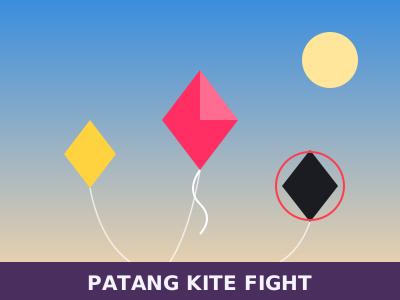
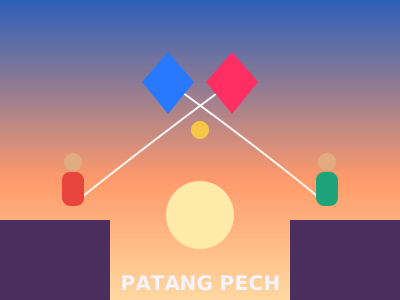
The playful side of the festival, the rivalry, the shouting and the technique, is what we wanted to capture in Patang Kite Fight and Patang Pech. In the one-player game you fly a kite, cut rival kites and avoid dangerous black manjha kites, with a combo bonus and a chikki power-up named after the festival sweet. In the two-player game, two flyers face each other and use dheel and khench to cut each other's strings.
Celebrating safely
The kite festival is joyful, but it also brings injuries every year. Sharp glass-coated and synthetic manjha harms birds and people, so choose plain cotton thread, which is enough for ordinary kite flying. Keep away from roads and power lines. Do not run backwards on a roof or lean over a parapet. Keep children supervised. Bird rescue groups run helplines every January, and you can look up the number for your own city before the festival starts. A festival that is safe for everyone, including the birds, is a better festival.
Other games for a festival day
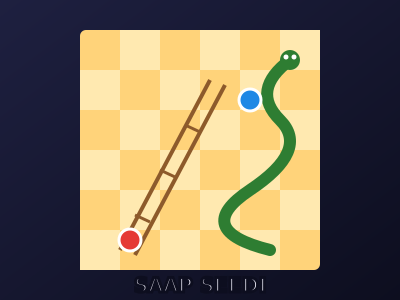
When the wind drops and the kites come down, families often turn to board games. Saap Seedi and Ludo Classic are both on the site and work well with several people around one phone. Cricket games also come out in January, especially Hand Cricket, a classic school game that needs nothing but two hands.
The festival across India
Although the kite is the best-known symbol in Gujarat and Rajasthan, the same moment in the calendar is marked in many ways. In Punjab, Lohri on the evening before is celebrated around a bonfire with songs, popcorn and peanuts. In Tamil Nadu, Pongal is a harvest festival of several days in which the first rice of the season is cooked until it boils over, a symbol of abundance. In Assam, Magh Bihu includes feasts and community bonfires. In Uttar Pradesh and Bihar, the day is often called Khichdi, after the dish prepared and shared. These traditions look different but share the same spirit of gratitude and the turning of the season.
Making it a family day
The best festival days are the ones everyone can join. Give younger children a simple kite and a short, strong plain-cotton string, and let older children and adults compete. Prepare food in advance so that no one has to leave the roof for long, keep water and sun protection close, and agree on a time to come down. If you cannot fly a real kite, playing a kite game together on a phone is a pleasant way to share the mood.
Why traditions like this matter
Festivals connect people across generations. A grandparent teaching a child to tie a knot on a kite string, or neighbours calling to each other across rooftops, creates memories that no game can replace. We hope our kite games are a small tribute and a way for people far from home to feel a bit of that sky.
Frequently asked questions
When is Uttarayan celebrated?
Uttarayan, the Gujarati name for the festival, is celebrated on 14 January each year, with Vasi Uttarayan, the second day, on 15 January.
Why do people fly kites on Makar Sankranti?
The festival marks the sun's move into the northern half of its yearly path. Flying kites is a way to spend long hours in the winter sun, and it has become the signature custom in states such as Gujarat and Rajasthan.
What do people eat?
Sesame and jaggery sweets such as tilgul and chikki are common across India, and Gujarat is known for undhiyu and jalebi on Uttarayan.