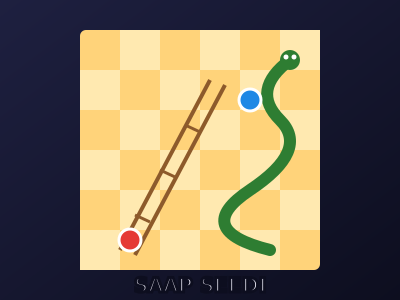
Few board games are as simple as Snakes and Ladders, and few have lasted as long. You roll a die, move your token, climb a ladder if you are lucky and slide down a snake if you are not. There are no decisions to make, which is precisely the point. This guide looks at the history of the game, the rules we use in Saap Seedi on OnlinePlayZone, and what the layout of the board does to the game.
A game with ancient Indian roots
Snakes and Ladders is generally traced to India, where a game often called Moksha Patam or Paramapada Sopanam was played as a teaching tool. The board used squares to represent stages of life. Ladders stood for virtues such as generosity and faith that lift a person upward, while snakes stood for vices such as anger and greed that pull a person down. The goal square represented liberation. The idea that good conduct climbs and bad conduct falls is a large part of why the game was passed on from generation to generation.
In the nineteenth century the game reached Britain, where it was sold as a family board game, and from there it spread around the world. Many modern versions lost the moral lessons and kept the fun. In India, the game is still widely known by its Hindi and Gujarati names, Saap Seedi, snake and ladder.
The rules we use
- The board has 100 squares, numbered in a zigzag from the bottom left to the top. The first row runs left to right, the second right to left, and so on.
- Players start off the board and take turns rolling one die. The token moves forward by the number rolled.
- If a token ends on the bottom of a ladder, it climbs to the top. If it ends on the head of a snake, it slides to the tail.
- Rolling a six gives the player another turn.
- To win you must land exactly on square 100. If a roll would take you past 100, the token stays where it is.
These are the most common household rules, but there are many variations. Some families require a six to start, some do not give extra turns for sixes, and some let you bounce back from 100 instead of staying still. It is worth agreeing on the rules before you start, especially when playing with children.
Why the game is pure luck
In most games the winner is decided by decisions. In Snakes and Ladders there is only one decision per turn and it has already been made for you: you must move the token by the rolled amount. Because of this, the outcome depends entirely on the dice. That is why the game is so suitable for young children, who cannot yet plan ahead, and why adults and children can play together on equal terms.
It is also why the game is a good way to teach early maths. Counting squares, adding numbers up to six, and understanding that big numbers do not always help (a big roll can land you on a snake) are all natural lessons. Many teachers also use the game to introduce the idea of probability: each face of the die is equally likely, and a long run of rolls evens out.
What the board layout does
Although you cannot influence your moves, the board layout shapes how long the game takes. A board with long ladders and few snakes produces short games, while a board with big snakes near the end produces dramatic comebacks. On our board, the longest ladder lifts a player from square 28 to square 84, which can turn a losing position into a winning one in a single turn. The most cruel snake sits at square 99 and drops a player all the way to square 80 just before the finish.
The last row is where games are most often decided. Because you need an exact roll, a player on square 97 can only use a one, two or three; any larger roll leaves them where they are. A single token can sit near the end for many turns while the opponent catches up.
Tips for playing with children
Let younger players count the squares out loud as the token moves, and encourage them to predict where they will land. Celebrate ladders, but also talk about snakes as a normal part of the game, not a punishment. Because nobody can play better or worse, nobody should feel they lost because they were not clever enough. That makes it a gentle first board game.
Play it online
In Saap Seedi you can play against the computer or pass a phone between two players. The game animates each step, so younger players can follow the token, and it keeps track of your wins in your browser. If you like games where choices matter, try Ludo Classic next: it uses dice too, but you choose which token to move.
Frequently asked questions
Is there any strategy in Snakes and Ladders?
No. Every move is decided by the die, so the game cannot be won by skill. That is exactly why it is popular with young children and mixed-age families: everyone has the same chance.
Why do I need an exact roll to finish?
It is the most common house rule. If your roll would take you past square 100, you stay where you are and try again, which makes the last few squares tense.
Where does the game come from?
It is generally traced to ancient India, where a game called Moksha Patam taught ideas about virtue and vice. The version people play today travelled to Britain in the nineteenth century and spread worldwide.