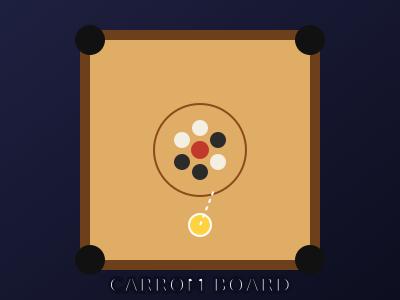
Carrom is played in homes, clubs and neighbourhoods across India and South Asia, and it is easy to see why. The rules are simple, the board fits on a table and a good game combines delicate control with a bit of geometry. This guide explains the board and rules and then covers the shots and habits that help beginners improve quickly, using the Carrom Board game on OnlinePlayZone as the example.
The board and the pieces
A carrom board is a smooth square wooden surface with a pocket in each corner. Each player sits on one side, with a baseline in front of them on which the striker is placed. There are nine white coins, nine black coins and one red coin, the queen, arranged in a circle at the centre of the board. The striker is a slightly heavier disc that you flick to hit the coins.
In our game you play the white coins and the computer plays black. You slide the striker to a position on your baseline, then pull it back like a slingshot and release. The farther you pull, the harder the hit.
The rules in short
- Your aim is to pocket all nine of your own coins before your opponent pockets theirs.
- If you pocket one of your own coins, you shoot again. If you do not, the turn passes.
- If you pocket your opponent's coin, it counts for them and your turn ends.
- The red queen is worth bonus points and gives another turn to whoever pockets it.
- If your striker falls into a pocket, it is a foul: you lose the turn and one of your pocketed coins is returned to the board as a penalty.
Real tournament rules add details, such as covering the queen and a fixed scoring system, but these are the rules that matter to a beginner.
Learn the ghost position
The most useful idea in carrom, and in pool and billiards, is the ghost position. Imagine a line from the pocket you want to the coin you want to pocket and extend that line backward behind the coin. The point on that line where the striker must touch the coin, one coin-and-striker radius behind it, is the ghost position. If the striker's centre arrives at that point, the coin will travel straight toward the pocket.
This means you should not aim the striker at the coin. You should aim it at the ghost position behind the coin. Beginners often aim straight at the middle of the coin, which sends it in the wrong direction unless the pocket happens to be directly behind it.
Choose the striker position first
You can slide your striker anywhere along the baseline, and that position is a big part of the shot. Before you pull back the striker, look at the coin and the pocket and choose a striker position that makes the line from the striker to the ghost position as straight as possible and as short as possible. A short, straight shot gives you the best control. If the angle between the line to the ghost position and the line from the coin to the pocket is very sharp, the shot is difficult. Try to find a coin where the cut angle is small.
Control the power
Most missed shots in carrom are missed by hitting too hard. A fast striker can bounce off a wall, take a coin the wrong way or fall into a pocket by accident. Use the lightest power that gets the coin to the pocket. Close shots need very little force. Long shots across the board need more, but even then you should aim for a smooth pull rather than a maximum pull.
Break the centre early
The coins start in a tight cluster at the centre, and a tight cluster is hard to pocket from. The first few turns should aim to open it up. A medium-power hit through the middle scatters the coins and creates loose coins near the edges that are much easier to pocket. Opening the cluster helps both players, but it helps the player who understands the ghost position more.
Use the walls
When a coin is hidden behind other coins, you can sometimes reach it with a bank shot. The striker bounces off a wall and then meets the coin. The angle of a bounce is predictable: the striker leaves the wall at the same angle it arrived. Imagine a mirror image of the board behind the wall and aim at the mirror image of the coin; the bounce does the rest.
Play defensively when you have to
If no safe shot is available, do not force a difficult attempt that could foul or hand your opponent an easy coin. A gentle shot that moves a coin away from a pocket or leaves the striker in a safe position is a perfectly good move. The computer in our game looks for the straightest and most open shot, so giving it easy targets is the quickest way to lose.
Practice routine
- Play a few rounds only shooting at coins near the edges, to learn the feel of power.
- Practise the ghost position on straight shots into the corner pockets.
- Then try cut shots with a small angle.
- Finally, add bank shots when the straight path is blocked.
A few sessions of focused practice are enough to move from random flicks to deliberate shots.
Frequently asked questions
What is the red coin in carrom?
The red coin is the queen. It is worth bonus points and, in many rule sets, must be covered by pocketing one of your own coins right after. In the OnlinePlayZone version it gives three bonus points and another turn.
What happens if the striker falls into a pocket?
That is a foul. In the usual rules you lose your turn and return one of your pocketed coins to the board as a penalty. Our game follows that rule.
Why do my shots go wide?
Usually the striker is hitting the coin too hard, or hitting it off-centre. A lighter, well-placed hit gives you far more control than a hard flick.